
0%

Choosing Programmable DC Power Supplies requires more than comparing voltage ranges and front-panel displays. A suitable unit must deliver stable, measurable power for the actual device under test. Engineers should examine output voltage, current capacity, power limits, ripple, noise, and transient response. A 0–30 V, 5 A supply may suit a small embedded circuit, but it will not support every motor or battery experiment. Check the datasheet carefully. Marketing terms can hide important operating limits.

Control and protection features also deserve close attention. Remote sensing can compensate for voltage drops across long test leads. Current limiting helps protect a prototype when a component fails unexpectedly. Overvoltage, overtemperature, and short-circuit protection provide valuable safeguards, but they are not substitutes for careful laboratory practice. Digital interfaces, such as USB, LAN, or RS-232, matter when tests must run repeatedly. Automation can record voltage and current readings more consistently than manual adjustment. Still, software integration is not always effortless. I have seen engineers overlook driver compatibility and lose hours during setup.

This guide presents a practical method for selecting Programmable DC Power Supplies. It considers application requirements, accuracy, resolution, response speed, channel configuration, and total ownership cost. Calibration records and independent test data can strengthen purchasing decisions. When possible, compare a candidate supply with a trusted meter under realistic loads. Test it cold, warm, and near its rated output. Small details matter. The best choice balances electrical performance, usability, safety, and future testing needs rather than relying on price alone.
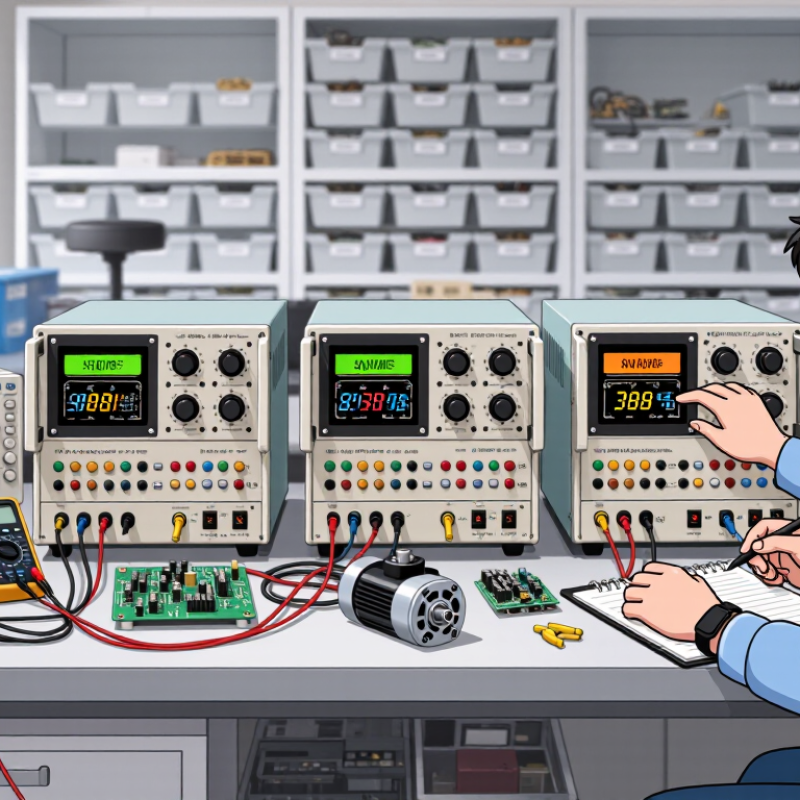
How to Choose Programmable DC Power Supplies?

Define the Application Requirements for a Programmable DC Power Supply

How to Choose Programmable DC Power Supplies?

Define the Application Requirements for a Programmable DC Power Supply

Start with the load, not the power supply catalog. Record the device’s operating voltage, maximum current, startup surge, and normal power range. A circuit needing 12 V at 2 A may briefly draw 8 A during startup. Missing that detail can cause unstable testing.

Write down the required voltage and current resolution. Battery research may need millivolt control and precise current limits. Motor testing may need fast transient response instead. Select a supply with enough headroom, but avoid excessive capacity that reduces measurement sensitivity. A practical margin of 20% is often useful, though demanding loads may require more.

Consider how the supply will be controlled. Manual operation may suit occasional bench checks. Automated production testing usually needs digital interfaces, repeatable presets, data logging, and clear programming commands. Check whether the response time matches the test sequence. A slow interface can become the real bottleneck.

Protection functions deserve careful attention. Overvoltage, overcurrent, overtemperature, and short-circuit protection should match the equipment under test. Remote sensing can compensate for cable loss, especially at higher currents. However, poorly connected sense leads may create unexpected output behavior.

Environmental conditions also matter. Check temperature, humidity, ventilation, noise, and available space. My early selections were sometimes too optimistic about cooling requirements. A supply that works on a quiet bench may behave differently inside a crowded test rack. Review the datasheet, test procedure, and applicable electrical safety requirements before ordering.

Compare Voltage, Current, Power, and Output Range Specifications

Choosing a programmable DC power supply starts with voltage, current, power, and output range. Voltage must exceed the device’s normal requirement, but excessive headroom can increase risk. For a 12 V circuit, a 0–20 V output offers useful testing space. Current capacity should cover startup surges, not only steady operation. I usually allow 20–30% headroom, although this rule is not universal.

Power equals voltage multiplied by current. A 30 V, 5 A supply provides 150 W, but thermal limits may reduce continuous output. Check the manufacturer’s derating curve. The International Energy Agency’s Global EV Outlook 2024 reported nearly 14 million electric car sales in 2023. That growth increases demand for supplies supporting higher-voltage battery testing, often around 400 V or 800 V architectures. Low-voltage laboratory work still needs fine adjustment and stable current limiting.

Output range also includes resolution, ripple, transient response, and channel tracking. A wide range is useful only when control remains precise. NIST Technical Note 1297 emphasizes evaluating measurement uncertainty, so display accuracy alone should not decide the purchase. Test a supply with a load close to your real application. Watch voltage recovery after a sudden current step. I once selected a unit by wattage alone; it passed the static test but reacted poorly to pulsed loads. That mistake still influences my checklist. Leave room for aging, cable losses, and future experiments. Specification tables rarely tell the whole story.

Select Regulation, Resolution, Accuracy, and Protection Features

Choosing a programmable DC power supply starts with regulation, not the display or maximum wattage. Constant-voltage mode maintains the selected voltage, while constant-current mode limits output when a load demands more current. Check both line and load regulation. Tight regulation keeps a sensitive circuit stable when mains conditions or connected devices change. A supply can look precise at no load yet drift under real demand.

Resolution determines the smallest voltage or current adjustment. Accuracy tells you how close the output is to the displayed value. These specifications are different. A display showing 0.001 V does not guarantee millivolt-level accuracy. Compare accuracy statements, temperature ranges, and calibration conditions. I once focused too heavily on resolution and overlooked load-dependent error. That mistake made a low-current sensor test less reliable than expected.

Tips: Test the supply with a representative load, not only a multimeter. Observe the output during startup, rapid setpoint changes, and repeated current limiting. Select overvoltage, overcurrent, and overtemperature protection that suits your circuit. Short-circuit protection should recover safely without damaging the load. Remote sensing can compensate for cable voltage drops, especially with long leads. Leave operating margin below the rated limits. Running near maximum power may increase heat and reduce long-term stability. Also inspect response speed, ripple, noise, and whether settings can be locked accidentally. A quiet laboratory bench is useful, but actual wiring is rarely perfect.

Evaluate Programming Methods, Interfaces, and Remote Control Options

How to Choose Programmable DC Power Supplies?

Programming methods determine how easily a power supply fits your test workflow. SCPI commands remain widely used because they support repeatable voltage ramps, current limits, and protection settings. According to the 2024 Test and Measurement Equipment Market report by MarketsandMarkets, automation and remote connectivity are major growth drivers in electronic testing. That trend matters on the bench. A USB connection may suit one instrument, while LAN control works better across a production network. GPIB is still dependable, but newer systems may treat it as legacy hardware.

Look closely at interface behavior, not only connector types. LAN control should support stable addressing, error reporting, and password protection. USB is convenient, but cable length and driver issues can interrupt a long test. RS-232 can be surprisingly useful for simple scripts. It is not glamorous. Remote control also requires practical feedback. Choose supplies that return measured voltage and current, not only programmed values. The difference becomes visible when a load suddenly changes.

In my testing experience, clear command documentation saves more time than a faster processor. Check software examples, trigger functions, data logging, and response timing before purchase. The 2023 Global Electronic Test Equipment Market analysis by Fortune Business Insights identifies automation as a key factor shaping equipment demand. Still, market forecasts are not laboratory evidence. Verify claims with a small trial: set a ramp, induce a load change, disconnect the cable, and inspect recovery behavior. A perfect interface on paper may feel awkward at 2 a.m.

How to Choose Programmable DC Power Supplies? — Evaluate Programming Methods, Interfaces, and Remote Control Options
Programming Method Typical Interface Communication Format Automation Capability Response and Timing Remote Monitoring Integration Difficulty Recommended Use
Front-Panel Programming Built-in display, keypad, rotary control, or touchscreen Manual entry; stored presets or sequences Basic voltage, current, output, and protection-limit adjustment Immediate operator control; timing depends on manual input Local only unless another interface is available Low Bench testing, setup, troubleshooting, and occasional adjustment
USB Remote Control USB device or USB-to-serial connection SCPI commands over a virtual COM port or USB driver Automated setpoints, measurements, test sequences, data logging, and pass/fail checks Generally suitable for slow-to-moderate test sequencing; host and driver latency may vary Yes, while connected to the controlling computer Low to Medium Single-instrument automation, laboratory scripts, and production test benches
RS-232 Serial Control DB-9, RJ-12, or terminal-block serial connector ASCII commands, often SCPI-compatible or instrument-specific Remote configuration, measurement queries, output sequencing, and status polling Reliable for command-based control; baud rate and cable length affect throughput Yes, through a local controller or serial server Medium Legacy systems, dedicated controllers, and electrically simple point-to-point links
LAN or Ethernet Control RJ-45 Ethernet port SCPI over TCP/IP, raw socket, VXI-11, or web-based control Multi-instrument control, centralized logging, scheduled testing, and network access Fast and convenient for distributed systems; network traffic can introduce variable latency Yes, from authorized computers on the network Medium Production lines, laboratory networks, remote engineering, and multi-device automation
GPIB Control IEEE-488 parallel instrument bus SCPI or command sets transmitted through a GPIB controller Coordinated control and measurement across multiple test instruments Deterministic command handling with strong suitability for established test systems Yes, through a connected controller or GPIB gateway High Existing automated test equipment, synchronized laboratory systems, and compatibility-focused installations
Digital I/O and Trigger Control TTL, CMOS, interlock, inhibit, trigger, or alarm terminals Electrical logic signals rather than text commands Output enable, emergency shutdown, sequence triggering, and hardware interlocking Very fast hardware response; exact timing depends on the circuit and specification Limited; status may be represented by logic or relay signals Medium Safety interlocks, synchronized test fixtures, and time-sensitive output control
Analog Programming Input Analog voltage or current control terminals Continuous analog signal, such as 0–5 V, 0–10 V, or 4–20 mA External control of output voltage or current within the configured programming range Fast and continuous; accuracy depends on signal resolution, noise, and calibration Usually limited to separate sense or monitor outputs Medium PLC systems, closed-loop control, power-system simulators, and industrial automation
Web Browser Interface Ethernet connection and standard web browser HTTP or HTTPS with a graphical control page Remote setup, live readings, configuration storage, and basic operational control Convenient for human interaction; not normally intended for precise real-time control Yes, subject to network security and user permissions Low to Medium Remote service, status checks, configuration, and occasional laboratory operation
Custom Software or API Control USB, LAN, serial, or vendor-neutral driver layer SCPI libraries, instrument drivers, REST-style APIs, or software development kits Fully customized workflows, database logging, dashboards, production integration, and error handling Depends on the underlying interface, software architecture, and command strategy Yes, when implemented with authenticated network or software access High Large-scale automation, software-defined test systems, and traceable production processes
Selection guideline: choose the interface that matches the required automation speed, cable distance, number of instruments, safety architecture, software environment, and cybersecurity policy. For repeatable automated testing, SCPI-based USB or LAN control is commonly practical; for hardware-level safety and synchronization, digital I/O or interlock connections should be evaluated separately.

Assess Form Factor, Safety Standards, Support, and Total Cost

How to Choose Programmable DC Power Supplies?

A programmable DC power supply should fit your workspace before you compare specifications. Bench models offer quick access, while rack-mounted units save valuable laboratory space. Measure depth, ventilation clearance, and cable reach. A compact unit can still become awkward when connectors face a crowded rear panel. I once overlooked airflow space and created unnecessary heat during long testing sessions. That mistake was avoidable.

Safety deserves equal attention. Check isolation ratings, overvoltage protection, overcurrent protection, and thermal safeguards. Verify test reports and certification documents against the standards required in your region. Do not rely only on a compliance label. Ask whether protection circuits recover automatically or require manual inspection. Support also matters. Clear manuals, calibration services, firmware guidance, and responsive technical assistance can reduce downtime. A low purchase price may look attractive until one failed channel interrupts a week of testing.

Tips: Calculate total cost over several years. Include cables, racks, calibration, energy use, repairs, training, and replacement time. Compare output stability under realistic loads, not only advertised ratings. Record noise, temperature, and programming response during a trial. Think carefully. Some buyers overvalue maximum voltage and ignore everyday usability. I have made that comparison error myself. A supply with fewer headline features may deliver better value when its controls, documentation, and service process remain dependable.

How to Choose Programmable DC Power Supplies?

Assess form factor, safety standards, technical support, and total cost before making a purchasing decision.

This illustrative evaluation model uses a 100-point weighting system. Total cost receives the highest weight because purchase price, energy consumption, maintenance, calibration, and downtime all affect long-term value. Safety standards and form factor should be confirmed against the intended application, installation environment, and applicable regulations.

FAQS

What load information should I record before selecting a programmable DC power supply?

Record operating voltage, maximum current, startup surge, and normal power range. A 12 V, 2 A circuit may briefly draw 8 A at startup. Missing this detail can cause unstable testing.

How much voltage and current capacity should the supply provide?

Choose enough headroom for the load and test conditions. A practical margin is about 20%, though demanding loads may need more. Excessive capacity can reduce measurement sensitivity. More is not always better.

Which resolution and response features matter for different applications?

Battery research may need millivolt voltage control and precise current limits. Motor testing may need fast transient response instead. Match the supply to the load’s behavior. I once focused too much on resolution.

Should I choose manual or automated control?

Manual control suits occasional bench checks. Automated production testing needs repeatable presets, digital control, logging, and clear commands. Check response time against the test sequence. A slow interface becomes the bottleneck.

Which programming methods can support repeatable testing?

SCPI-style commands can create repeatable ramps, current limits, and protection settings. Confirm command syntax and examples before purchase. A small trial is valuable. Documentation often matters more than speed.

How should I compare USB, LAN, GPIB, and RS-232 control?

Choose the interface that fits your workflow and distance. LAN can suit production networks with stable addressing and error reporting. USB is convenient, but drivers and cable length may cause interruptions. RS-232 remains useful for simple scripts. GPIB may feel like legacy hardware.

What protection and sensing functions should I check?

Look for overvoltage, overcurrent, overtemperature, and short-circuit protection. Remote sensing can compensate for cable loss at higher currents. Poorly connected sense leads may cause unexpected output behavior. Check the wiring twice.

How can I verify remote-control performance before buying?

Set a voltage ramp, create a load change, disconnect a cable, and inspect recovery. Check measured voltage and current feedback, not only programmed values. Review trigger functions, logging, and response timing. Paper specifications can disappoint at 2 a.m.

Which environmental conditions affect selection and installation?

Check temperature, humidity, ventilation, noise, and available rack space. A quiet bench differs from a crowded test rack. Review cooling requirements and applicable electrical safety requirements. My earlier choices were too optimistic.

Conclusion

Choosing the right Programmable DC Power Supplies begins with clearly defining the application, including required voltage, current, power capacity, output range, load behavior, and operating environment. Compare specifications carefully to ensure the supply can meet both normal and peak demands without operating continuously at its limits. Regulation, resolution, accuracy, and response speed are also important, especially for sensitive testing, automated production, and repeatable laboratory work. Built-in protections such as overvoltage, overcurrent, overtemperature, and short-circuit protection can help safeguard both the equipment and the connected load.

Next, evaluate how the supply will be controlled and integrated into your system. Consider front-panel operation, software control, communication interfaces, remote sensing, data logging, and compatibility with existing automation tools. The physical form factor should suit available space and installation requirements, while appropriate safety certifications and clear operating documentation support reliable use. Finally, assess technical support, warranty coverage, maintenance needs, energy efficiency, and long-term ownership costs rather than focusing only on the initial purchase price.

Ethan

Ethan

Ethan is a professional marketing specialist with a strong understanding of product strategy, customer needs, and industry trends. As a key member of our company, he combines practical marketing experience with in-depth knowledge of our products and services, helping customers better understand how......