1. Strategic Context: Italy’s Automotive Legacy & Electrification Pivot
Italy holds a world-renowned position in automotive engineering. From the legendary Motor Valley in Emilia-Romagna—home to Ferrari, Lamborghini, Maserati, and Ducati—to the industrial manufacturing hubs of Turin (Piedmont) and Lombardy, the Italian motor ecosystem is undergoing a fundamental transformation. As the European Union moves toward strict emissions mandates and zero-emission transit by 2035, Italian manufacturers and academic institutions are aggressively transitioning from traditional internal combustion engine (ICE) testing to advanced electric vehicle (EV) motor drive simulation and Hardware-in-the-Loop (HIL) validation.
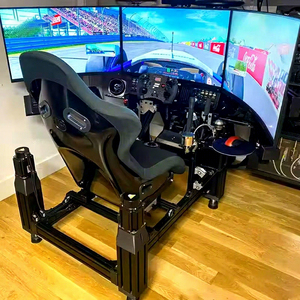
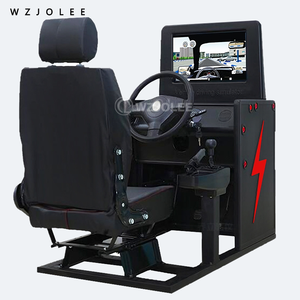
Simultaneously, the demand for precise dynamic motion simulation has expanded beyond traditional vehicle prototyping into vocational training (Istituti Tecnici Superiori - ITS), professional driving academies (Autoscuole), and immersive commercial entertainment centers across major urban nodes like Milan, Rome, Naples, and Rimini. Factory-direct motor simulator supply chains are crucial to providing the mechanical fidelity, ultra-low dynamic latency, and long-term operating reliability required by Italian procurement authorities.
Technical Information Gain: Linear Servo Actuators vs. Hydraulic Motion Platforms
Modern Italian engineering facilities are rapidly replacing legacy hydraulic motion rigs with high-frequency electric linear servo actuator systems. Electric servo platforms offer zero hydraulic fluid contamination risks, reduce ambient noise operating parameters below 55 dB, and deliver sub-2 millisecond control loop response times. This allows instantaneous force-feedback modeling of slip angles, tire deflection, and high-frequency chassis anti-squat characteristics under heavy load conditions.
2. Kinematic Mechanics of 6DOF Stewart Platforms in Motor Simulation
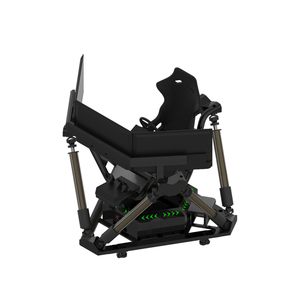
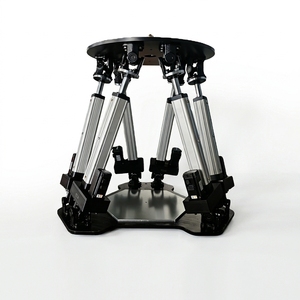
At the core of professional vehicle and flight motor simulators lies the 6-Degree-of-Freedom (6DOF) Stewart platform motion architecture. By arranging six closed-loop linear electric actuators in a hexapod configuration, the simulator reproduces all primary spatial motion vectors:
-
Translational Vectors: Surge (longitudinal acceleration/braking), Sway (lateral cornering load), and Heave (vertical suspension displacement).
-
Rotational Vectors: Roll (chassis lean during cornering), Pitch (weight transfer under pitch acceleration), and Yaw (vehicle tail rotation and oversteer dynamics).
Our factory utilizes high-torque Permanent Magnet Synchronous Motors (PMSM) paired with planetary ball-screws to achieve acceleration rates exceeding 1.2G. By integrating high-resolution optical encoders (up to 23-bit resolution) and CAN-bus motion controllers, our 6DOF platforms map vehicle physics software output (such as Assetto Corsa Pro, rFactor Pro, or MATLAB/Simulink EV models) into real-world physical motion with zero perceivable phase lag.
3. Structural Comparison of Motor Simulation Systems
To assist procurement managers and technical directors in selecting the optimal system architecture for Italian installations, the following matrix outlines the key operating metrics across our specialized hardware series:
| Simulator Class |
Motion Architecture |
Actuator Type |
Payload Capacity |
Primary Application in Italy |
| 6DOF Servo Platform (800kg) |
6-Axis Hexapod Stewart |
AC Servo / Ball-Screw |
800 kg max |
University R&D, Aerospace, Heavy Automotive Testing |
| 4DOF + Surge Cockpit |
4-Axis Pitch/Roll/Heave/Surge |
Linear Servo Actuators |
350 kg max |
Professional Driving Academies & Commercial Sim Centers |
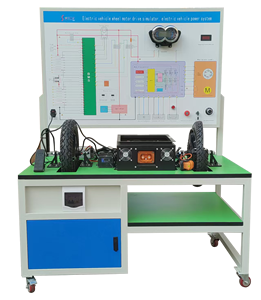
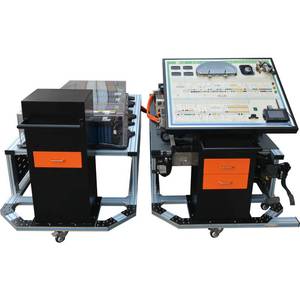
| EV Powertrain Teaching Bench |
Stationary / Dynamic Load |
PMSM / Inverter Bench |
N/A (Bench) |
Technical High Schools (ITS) & Vocational Institutions |
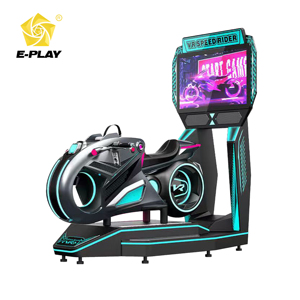
| Commercial VR Motorcycle Rig |
360-Degree Rolling Axis |
High-Torque BLDC Motor |
200 kg max |
Amusement Parks, FECs & Brand Promotional Events |