Choosing the best Double Pulse Testing Power Supplies in China requires more than comparing prices or advertised output ratings. Engineers should examine voltage stability, current response, pulse timing, cooling design, and measurement compatibility. A reliable unit must deliver repeatable energy pulses without creating unnecessary electrical noise. Small timing errors can distort switching-loss measurements, especially during high-frequency tests.
Practical evaluation begins with the supplier’s engineering evidence. Look for clear datasheets, calibration records, thermal test results, and documented protection functions. Ask whether the power supply supports the required device type, bus voltage, pulse width, and load conditions. Experienced manufacturers should explain these limits in measurable terms. Vague claims are not enough. Real laboratory support matters.
A strong Chinese supplier should also provide responsive technical communication, replacement parts, and stable quality control across production batches. Certifications can support credibility, but they do not replace independent verification. No supplier is perfect. Even a well-designed system may need custom cables, improved shielding, or software adjustments. That is why sample testing remains essential before a larger purchase. This guide compares key technical and commercial factors behind China’s leading options, helping laboratories select Double Pulse Testing Power Supplies with greater confidence, safety, and measurement reliability.
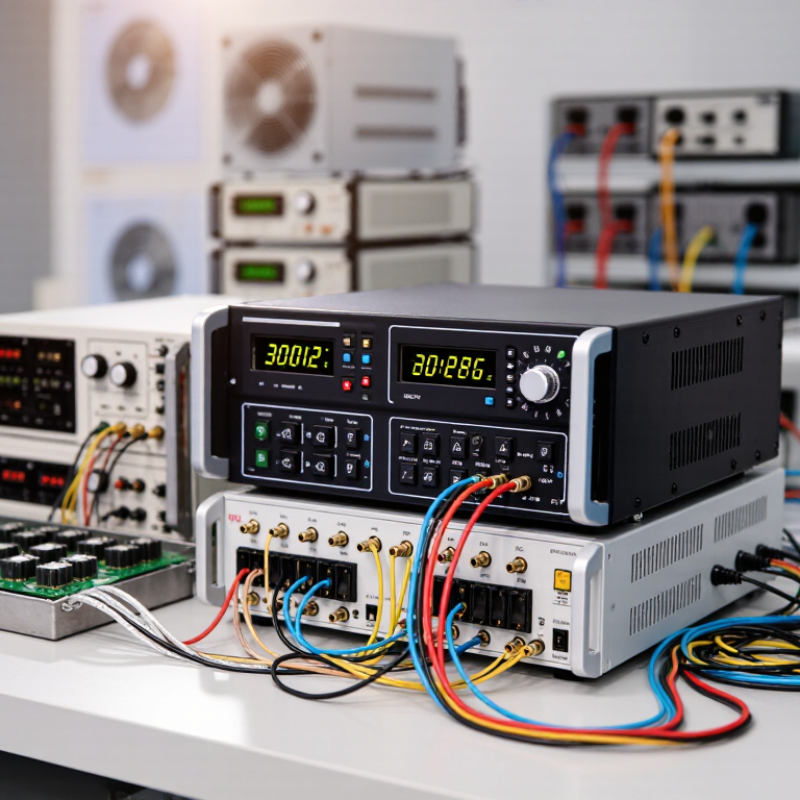
A double pulse testing power supply provides controlled DC energy for evaluating power switches, such as MOSFETs and IGBTs. It does not create the two gate pulses itself. Instead, it charges a DC-link capacitor and supplies the test circuit with a stable voltage. A pulse generator controls the switching sequence. The first pulse builds current through an inductor. The second pulse turns the device on or off under a known load. Engineers can then observe switching loss, voltage overshoot, current rise, and reverse-recovery behavior.
A reliable setup needs more than high output power. Low output ripple matters because unstable bus voltage can distort test results. Fast current limiting protects the device during wiring errors or unexpected oscillation. Short connections and low stray inductance are equally important. During laboratory checks, engineers should match the supply voltage, current rating, capacitor size, probe bandwidth, and cooling method. Safety interlocks and discharge circuits should also be verified before energizing the bus.
China offers many configurable testing supplies, but “best” depends on the application. A compact unit may suit low-voltage development, while a higher-voltage system needs stronger insulation and controlled charging. One easy mistake is judging performance only by the nameplate rating. Real switching behavior can change with cable length, grounding, and probe placement. Results may look acceptable, yet still hide measurement error. Careful calibration and repeated pulses are necessary. Perfect waveforms are not always realistic. Reflection is part of good engineering.
| Evaluation Dimension | Typical Specification or Configuration | Why It Matters in Double-Pulse Testing | Recommended Selection Criteria |
|---|---|---|---|
| Basic Function | A controlled DC-link power source used with a double-pulse test circuit, gate driver, high-current inductor, switching device, and measurement system. | The power supply establishes the test-bus voltage and provides the stored energy required to evaluate switching behavior. | Choose a supply specifically suited to pulsed-load operation rather than relying only on continuous-output ratings. |
| Output Voltage Range | Common laboratory ranges include 0–400 VDC, 0–800 VDC, or higher-voltage configurations for specialized power devices. | Bus voltage directly affects turn-on loss, turn-off loss, overshoot, electromagnetic interference, and device stress. | Select a voltage range that covers the target application while maintaining adequate insulation and measurement safety margins. |
| Output Current Capability | Continuous current may range from several amperes to tens of amperes; short-duration pulse current is normally handled by the test circuit and local energy storage. | The supply must replenish the DC-link capacitor without excessive voltage droop during repeated tests. | Compare both continuous current and transient response. Do not use continuous current as the only indicator of pulse capability. |
| Power Rating | Typical laboratory systems range from approximately 1 kW to more than 10 kW, depending on bus voltage, repetition rate, and device power level. | Higher average power is required when tests are repeated frequently or when the DC-link capacitor must be recharged rapidly. | Calculate average test energy and recharge demand instead of selecting a supply only from the peak pulse power. |
| Voltage Regulation | Programmable regulation with low steady-state ripple; the exact performance depends on the supply topology, load, and operating range. | Stable bus voltage improves the repeatability of switching-loss, reverse-recovery, and overshoot measurements. | Look for a clearly stated regulation specification under dynamic and near-rated-load conditions. |
| Output Ripple and Noise | Low-ripple DC output is preferred; the acceptable level depends on the voltage rating, measurement bandwidth, and device under test. | Excessive ripple can introduce uncertainty into current and voltage waveforms and may interfere with high-bandwidth probes. | Check ripple using the manufacturer’s stated bandwidth and measurement method, and verify compatibility with the oscilloscope setup. |
| Dynamic Response | Fast control-loop response with controlled recovery after load changes and capacitor charging events. | A slow or poorly damped response can cause bus-voltage fluctuation, ringing, or unwanted interaction with the test fixture. | Review load-transient data, recovery time, and overshoot rather than judging performance from nominal output ratings alone. |
| Remote Programming | Common interfaces include analog programming, USB, Ethernet, RS-232, or other digital control interfaces. | Remote control allows automated voltage sequencing, interlocks, data logging, and repeatable test procedures. | Prefer an interface that supports programmable limits, output monitoring, fault reporting, and test-system integration. |
| Voltage and Current Sensing | Integrated readback for output voltage and current, with remote-sense terminals available on some configurations. | Accurate readback helps confirm the actual DC-link condition and detect abnormal charging or leakage. | Use remote sensing when cable resistance or fixture wiring could create a meaningful voltage error. |
| Protection Functions | Overvoltage protection, overcurrent protection, overtemperature protection, short-circuit protection, and output inhibit. | Double-pulse fixtures can experience device failure, wiring faults, and rapid transients that require immediate energy isolation. | Prioritize adjustable protection thresholds, fast shutdown, fault latching, and a clearly defined discharge path. |
| Energy Discharge and Safety | External or integrated bleeder resistor, discharge circuit, DC-link isolation, emergency stop, and access interlock. | Charged capacitors can retain dangerous energy after the supply is switched off. | Confirm the discharge time, residual-voltage indication, grounding arrangement, and safe-access procedure before operation. |
| Isolation and Grounding | Output isolation and chassis-ground provisions must be compatible with the device-under-test circuit and measurement instruments. | Improper grounding can create measurement errors, ground loops, common-mode current, or hazardous touch voltages. | Review isolation ratings, floating-output limits, grounding instructions, and probe common-mode requirements. |
| Pulse Repetition Rate | Single-shot operation to repeated testing at a user-defined rate, limited by capacitor recharge, thermal conditions, and test-fixture recovery. | Repetition rate determines average power, component heating, and how quickly the DC-link voltage returns to its set point. | Verify performance at the intended repetition rate, not only during a single low-duty-cycle test. |
| Compatibility with Wide-Bandgap Devices | Suitable for silicon carbide and gallium nitride testing when combined with low-inductance layout, appropriate probes, and a fast gate driver. | Wide-bandgap devices switch quickly and are more sensitive to parasitic inductance, probe technique, and measurement bandwidth. | Use a low-inductance test loop and confirm that the supply, fixture, probes, and oscilloscope have adequate voltage and bandwidth ratings. |
| Calibration and Accuracy | Traceable calibration for voltage and current readback, with documented accuracy and repeatability. | Reliable switching-loss and efficiency calculations depend on accurate electrical measurements. | Request calibration information, uncertainty data, and the conditions under which accuracy specifications apply. |
| Physical Integration | Bench-top or rack-mount construction with accessible terminals, forced-air cooling, and adequate clearance for high-voltage wiring. | A practical mechanical layout reduces wiring length, parasitic inductance, thermal stress, and accidental contact risk. | Match the enclosure, cooling method, terminal arrangement, and installation requirements to the laboratory test station. |
| Best Overall Choice | A programmable, low-ripple DC source with suitable voltage and current margins, fast transient behavior, comprehensive protection, and remote control. | No single specification determines suitability; system-level compatibility with the double-pulse fixture is the deciding factor. | Evaluate the complete test setup, including DC-link capacitance, bus voltage, pulse current, switching speed, repetition rate, safety, and measurement equipment. |
It provides stable DC energy for testing power switches under controlled switching conditions. It charges a DC-link capacitor, while a separate pulse generator controls gate timing.
The first pulse builds current through an inductor. The second pulse switches the device under a known load. Engineers observe voltage, current, ringing, and switching loss.
It can reveal switching energy, voltage overshoot, current rise, and reverse-recovery behavior. Switching energy comes from integrating the voltage-current product over time.
Ripple changes the DC bus during testing. That change can distort switching waveforms and produce unreliable comparisons. Stable voltage is essential.
Match maximum bus voltage, charging current, power rating, capacitor size, and protection response. Check continuous and peak current ratings separately. Leave about 20% voltage headroom.
No. Long cables, weak grounding, and high stray inductance can create false spikes. A powerful supply cannot repair poor probe placement.
Use short, low-inductance connections and suitable probe bandwidth. Avoid long ground leads. Calibrate instruments and repeat pulses under recorded conditions.
Check safety interlocks, discharge circuits, current limiting, cooling, and short-circuit behavior. Confirm these functions before energizing the capacitor.
Not always. Temperature, parasitic capacitance, probe limits, and device variation can change results. A clean waveform may still mislead.
Engineers may prioritize fast recovery and overlook ripple. I once made that tradeoff myself. It needed reconsideration. Real testing is less perfect.
Double Pulse Testing Power Supplies are specialized instruments used to evaluate the switching behavior and performance of power semiconductor devices under controlled conditions. By generating two precisely timed voltage or current pulses, they help engineers examine turn-on and turn-off characteristics, switching losses, parasitic effects, overshoot, ringing, and thermal response. This testing method is valuable for improving circuit reliability, efficiency, and overall power conversion design.
When evaluating China-made Double Pulse Testing Power Supplies, users should consider output voltage and current range, pulse-width and timing resolution, repetition rate, rise and fall times, measurement synchronization, protection functions, cooling design, and control flexibility. Different applications may require compact laboratory units, high-power systems, or customized platforms for specific device technologies. The best choice should match the tested component, target operating conditions, required measurement accuracy, available workspace, safety requirements, and long-term maintenance needs. A balanced evaluation of technical performance, usability, documentation, and after-sales support can help ensure dependable and repeatable test results.