Buying Water-Cooled DC Power Supplies requires more than comparing voltage, current, and price. These units support demanding environments, including battery testing, electrolysis, semiconductor processing, and laboratory production lines. Their cooling systems can improve thermal stability, but they also add pumps, hoses, sensors, fittings, and maintenance points. A compact unit may look efficient on a specification sheet. Its installation footprint may tell a different story.
Power-electronics engineer Christophe Basso is widely respected for his work on converter design and control. A practical principle associated with his engineering approach is: “Every design is a compromise between performance, cost, and reliability.” That idea matters when selecting Water-Cooled DC Power Supplies. Maximum output is only one part of the decision. Ripple, response speed, coolant compatibility, protection functions, service access, and warranty support deserve equal attention.
These seven buying tips will help readers inspect the complete system, not just the front panel. Check whether the cooling loop matches your facility. Confirm the supply’s continuous rating, not only its short-term peak. Examine alarm behavior when flow drops or coolant temperature rises. Ask how filters, seals, and pumps are replaced.
Small details matter.
A forgotten fitting can stop production. A poorly sized hose can reduce cooling performance. Noise, condensation, and water quality may also affect daily operation. The right choice is rarely the cheapest model. It is the supply that remains stable, serviceable, and predictable under real load. Even experienced buyers can overlook one connection detail. That is why careful comparison, documented testing, and honest reflection should guide the final purchase.
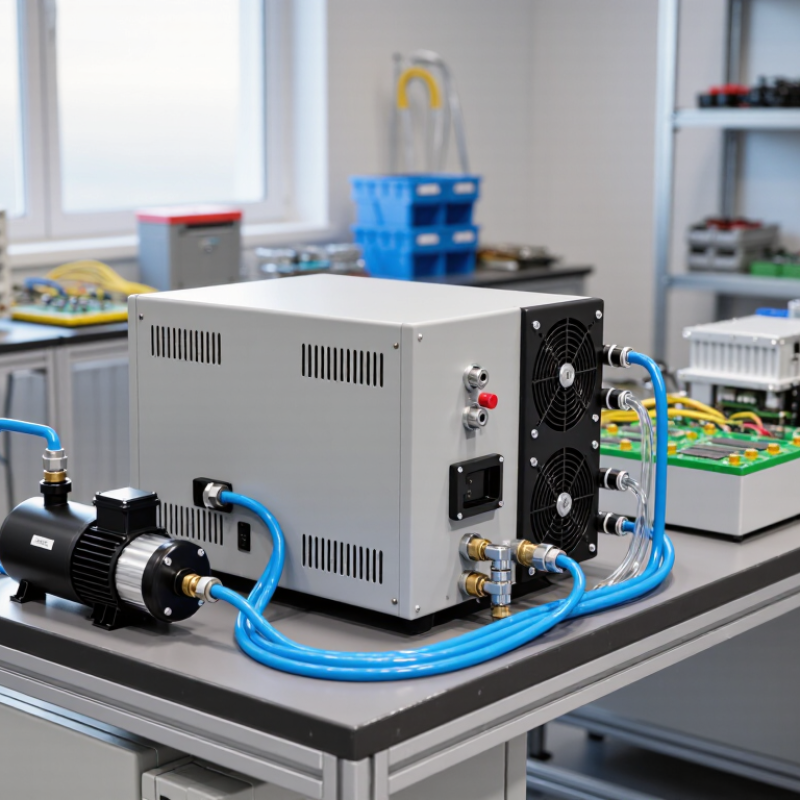
Buying a water-cooled DC power supply starts with a precise load definition. Record the required output voltage, continuous current, peak current, and duty cycle. Do not size only from the nameplate load. A test bench may draw 180 A normally, then demand 260 A during a short pulse. That pulse changes converter and cooling requirements. IEC 60146 expects clear operating and test conditions. Document input range, ambient temperature, and water temperature. Measure it twice.
Tip 1: Set the voltage window. Include regulation tolerance, cable drop, and startup overshoot the load can survive.
Tip 2: Separate continuous, overload, and peak current ratings. Ask how long each level is permitted.
Tip 3: Calculate power at the worst credible point, not the average. Voltage multiplied by current is basic, but efficiency and transient margin still matter. A 20 kW estimate may become 24 kW.
Tip 4: Define ripple in measurable terms. Specify RMS or peak-to-peak value, bandwidth, probe arrangement, and load condition. Otherwise, suppliers may report different results.
Tip 5: Check ripple during water-temperature changes and rapid load steps.
Tip 6: Confirm that IEC 60146 test data matches your installation.
Tip 7: Request a witnessed test at your actual voltage and current. This costs time. It can prevent an expensive redesign.
My own preference is a conservative margin, though excessive margin wastes energy and money. Recheck every assumption before ordering.
7 Tips for Buying Water Cooled DC Power Supplies?
Efficiency above 90% is valuable, but the percentage alone can mislead. At 1,000 watts output, a 90% supply releases about 111 watts as heat. At 95%, heat loss drops to roughly 53 watts. That difference can reduce water flow demands and extend component life. Check the efficiency curve at your actual operating load, not only the advertised peak.
Tip 1 Request test data at your voltage, current, and duty cycle. A supply may exceed 90% near full load but perform worse during standby.
Tip 2 Calculate total heat dissipation before installation. Include internal losses, cables, and nearby equipment.
Tip 3 Confirm the cooling rating with realistic water conditions. Inlet temperature, flow rate, pressure drop, and coolant quality all affect performance.
I have seen systems overheat because buyers trusted a nominal efficiency figure. I once underestimated partial-load losses myself. The water felt cool, yet a thermal camera showed hot spots near the switching stage. Leave thermal margin. A unit rated for a laboratory environment may struggle in a sealed cabinet at 35°C. Compare continuous and peak ratings, then ask for independent test records, protection thresholds, and maintenance requirements. A clear coolant path matters. So does easy inspection.
Water flow should match heat load, not just the power supply’s hose size. Use the practical equation: flow rate = heat load ÷ (4.18 kJ/kg·K × allowable temperature rise) A 2 kW supply with a 5°C water rise needs about 0.096 kg/s, or roughly 5.7 L/min. The 4.18 value represents water’s specific heat capacity near room temperature. NIST thermophysical data supports this engineering approximation.
Leave a safety margin. Real systems lose heat through fittings, pumps, and nearby components. If the supply operates at 90% efficiency, a 2 kW output may create about 222 W of internal heat, not 2 kW. Check the specification carefully.
The U.S. Department of Energy reports that cooling can consume up to 40% of data-center electricity, showing why oversized flow can waste energy. However, undersizing is worse. A small flow error can create a hot outlet and unstable operation.
Measure during commissioning. Install a calibrated flow meter, two temperature sensors, and a visible filter. Remove trapped air before trusting the readings. ASHRAE Thermal Guidelines for Data Processing Environments emphasizes controlled thermal conditions and reliable monitoring. I would not rely on the calculation alone. Water quality, altitude, glycol content, and fouled channels change performance. A five-minute test under real electrical load often reveals more than a polished catalog table. Check the result again after several hours.
7 Tips for Buying Water Cooled DC Power Supplies
Tip 1: Check cooling-loop pressure before comparing electrical ratings. A stable loop protects the power supply during long, high-load operation. Ask for the required inlet pressure, flow range, and temperature limits. Measure pressure at the equipment connection, not only at the pump. Small differences matter. I once overlooked a restrictive fitting during an installation review. The supply ran, but its thermal margin was poor.
Tip 2: Examine every wetted material. Copper, stainless steel, seals, and plastic fittings must suit the coolant chemistry. Mixed metals can create galvanic corrosion. Confirm the recommended coolant and its maintenance requirements. Do not assume treated water is harmless. Its quality can change with storage, temperature, and contamination. Request material data and compatibility evidence from the manufacturer.
Tip 3: Treat leak prevention as a purchasing requirement. Inspect the cooling plate, joints, drain points, and hose connections. Look for pressure-test records and clear leak-detection guidance. A minor drip near high-voltage circuitry deserves immediate attention. It may begin slowly. Ask how the unit behaves after coolant loss, blocked flow, or pump failure.
Tip 4: Review corrosion protection and service access. Choose designs that allow visual inspection, flushing, and filter replacement without complicated disassembly. Check whether internal passages can collect particles. Ask about inspection intervals and replacement seals. Documentation is useful, but it is not perfect. Have a qualified technician verify the loop before full-power commissioning.
Use these representative engineering reference values when evaluating a water-cooled DC power supply. Always confirm the final limits against the supplier’s specification, component ratings, coolant chemistry, and site conditions.
Key checks: Verify coolant temperature and operating pressure, confirm that the wetted materials are compatible with the coolant, require a documented leak test, inspect seals and fittings, control pH and conductivity, use corrosion protection where appropriate, and plan regular monitoring of flow, temperature, pressure, and coolant quality.
Buying a water-cooled DC power supply requires more than checking voltage, current, and cooling capacity.
Safety and electromagnetic compatibility must fit the installation environment. A sealed cooling loop should prevent leaks near terminals, control boards, and insulation barriers. Ask how the unit manages condensation during cold starts. Small details matter.
IEC 62368-1 focuses on protecting users from electrical, thermal, and energy-related hazards. Confirm that the evaluation covers the complete power supply, not only a separate module.
Request the test report, certificate scope, insulation ratings, touch-current results, and abnormal-operation data.
Check whether the stated input and output conditions match your application. A certificate with unclear limits creates uncertainty.
IEC 61000-6-2 addresses immunity in industrial environments. Verify testing for electrostatic discharge, radiated radio-frequency fields, fast transients, surges, and conducted disturbances.
Ask whether tests were performed with the water pump, hoses, sensors, and control cables connected. Those cables can change the result.
In practice, grounding errors and long DC leads often cause unexpected resets.
I would also inspect the installation manual for bonding points, cable routing, and recommended protective devices. A missed detail can become an expensive lesson.
Higher efficiency produces less heat. At 1,000 watts, 90% efficiency creates about 111 watts of heat.
Not completely. Request test data at your actual voltage, current, load, and duty cycle.
Use output power multiplied by the loss percentage. A 2 kW output at 90% efficiency creates about 222 watts of heat.
If the supply produces 222 watts of heat and allows a 5°C water rise, flow is about 0.096 kg/s.
Check inlet temperature, flow rate, pressure drop, coolant quality, and glycol content.
No. Flow must match the actual heat load and permitted temperature rise.
Install a calibrated flow meter, two temperature sensors, and a visible filter.
Leave extra capacity for warm rooms, sealed cabinets, partial-load losses, and aging components.
Choose an accessible coolant path, simple inspection points, clear protection thresholds, and documented maintenance requirements.
Choosing Water-Cooled DC Power Supplies requires careful evaluation of both electrical performance and cooling-system reliability. Begin by defining the required output voltage, current, power, and allowable ripple in accordance with IEC 60146. Compare units with efficiency ratings above 90%, while considering total heat dissipation rather than efficiency alone. Proper water-flow sizing is also essential; use water’s approximate heat capacity of 4.18 kJ/kg·K to estimate the flow needed to remove the expected thermal load without excessive temperature rise.
Before purchase, inspect the cooling loop’s operating pressure, tubing and fitting materials, leak-prevention measures, and resistance to corrosion. Compatibility between the coolant and internal components can significantly affect service life and maintenance requirements. Finally, verify that the power supply has been evaluated for applicable safety and electromagnetic compatibility requirements, including IEC 62368-1 and IEC 61000-6-2. A balanced review of electrical specifications, thermal performance, mechanical design, and compliance will help ensure dependable operation in demanding applications.